


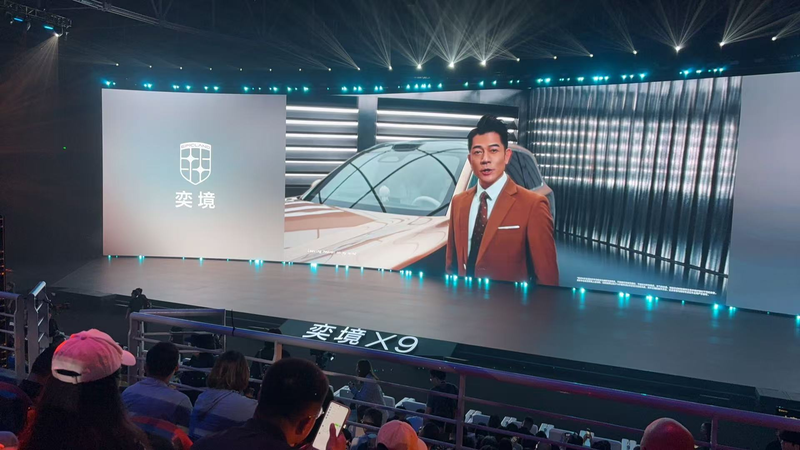
Just when you thought the Huawei ecosystem could not possibly absorb another automaker, along comes Yijing — and its first model, the X9, launched today with pre-sale pricing that reads like a statement of intent: RMB 299,800 (USD 44,300) for the entry Max Long Range, RMB 339,800 (USD 50,200) for the Ultra+ Long Range, and RMB 379,800 (USD 56,100) for the range-topping Ultra+ Flagship Long Range.
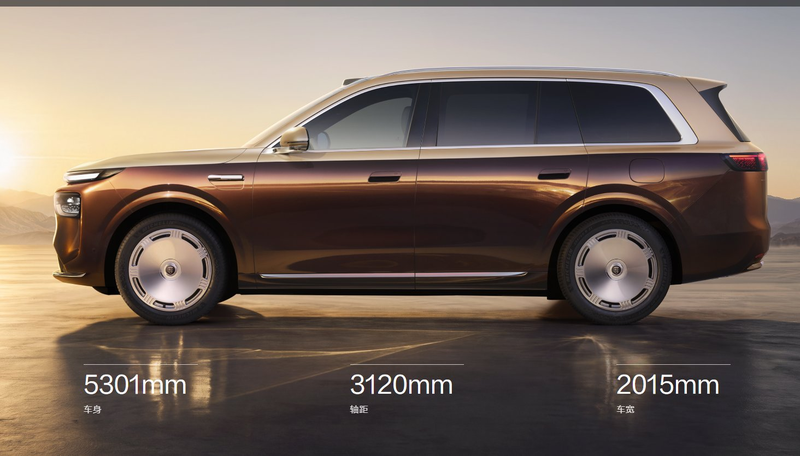
The X9 is a full-size EREV SUV aimed squarely at the Li Auto L9 and AITO M9 crowd. It stretches 5,301 mm long, 2,015 mm wide and rides a 3,120 mm wheelbase — big six-seat family territory, with dual zero-gravity seats, massaging thrones, Nappa leather everywhere and a MOFs air filter built on that 2025 Nobel Prize-winning chemistry. The design team talks about "0.618 golden ratio" proportions and a gold-brown two-tone paint job applied with a 5C2B process borrowed from million-yuan luxury cars.
But the real story is under the skin, and it is spelled H-U-A-W-E-I. Every trim gets the full HUAWEI ADS 5 suite as standard — a four-LiDAR setup pairing one 896-line main unit with three high-precision solid-state sensors, wrapped in the CAS 5.0 collision-avoidance system and the Qiankun Chitu platform. Inside, the X9 is among the first to run HarmonySpace 6, with a butterfly-wing dual screen, the MoLA intelligent agent, a cutesy "HAMOMO" AI companion, and a HUAWEI XSCENE in-car laser projection system that turns the cabin into a private cinema. Even the headlights are million-pixel XPIXEL units.
Safety kit follows the same all-in philosophy: a 2,400 MPa ultra-high-strength steel body, a three-layer "bulletproof" battery armor — an industry first, the company claims — a multi-redundancy rescue system, and three TOP challenge certifications from CATARC.
Here is the thing, though. Spec-for-spec, the X9 outguns cars costing half as much, and the entry price undercuts the AITO M9 by a comfortable margin. In the great Chinese NEV price war of 2026, "standard-fit four LiDARs" is no longer a punchline — it is the bar for entry. The X9 will live or die not on its hardware list, but on whether shoppers can tell Yijing apart from the half-dozen other Huawei-flavored badges in the showroom. Judging by the launch spectacle, the brand intends to make that part easy.
Editor's Note: Full Huawei stack, standard four LiDARs, sub-RMB 300k entry — the AITO M9's biggest threat now wears a different badge. The interesting question is not whether the X9 sells, but who at Huawei decides which ecosystem brand gets to win.
— need a chat about China NEV market? mail me @ sheng.ye@ipsos.com